
xTool F2 Ultra 60W MOPA & 40W Diode Dual Laser Engraver





xTool F2 Ultra 60W MOPA & 40W Diode Dual Laser Engraver
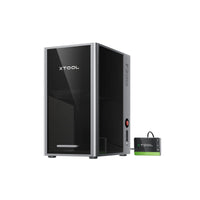
xTool F2 Ultra Dual-Laser Engraver — 60W MOPA Fiber + 40W Diode
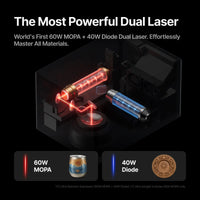
The xTool F2 Ultra is xTool's most powerful desktop dual-laser engraver, combining a 60W MOPA fiber laser with a 40W diode laser for professional-grade engraving, cutting, and color marking. The MOPA fiber laser unlocks capabilities unavailable on standard fiber systems — most notably 100+ consistent colors on metal through precise pulse control — while the 40W diode handles deep cuts in wood, acrylic, leather, and other organics at high speed.

Why the xTool F2 Ultra Stands Out
🎨 100+ Vibrant Colors on Metal — MOPA Fiber Advantage
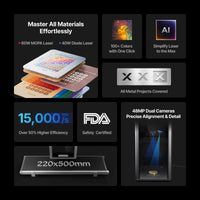
Unlike standard fiber lasers, the F2 Ultra's 60W MOPA (Master Oscillator Power Amplifier) fiber laser allows independent control of pulse width and frequency. This unlocks a full spectrum of 100+ repeatable, consistent colors on stainless steel and other metals through controlled oxidation — ideal for branded jewelry, premium product personalization, decorative metalwork, and color ID tags. Color results are consistent across batches, making it viable for production use.
📷 48MP Dual Camera System — Precision Alignment at Any Scale
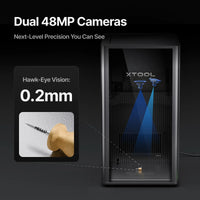
The F2 Ultra's 48MP dual camera system (panoramic + close-up) delivers the highest camera resolution in xTool's lineup, enabling precise design placement even on small or intricate items. The high-resolution close-up camera is particularly valuable for jewelry, small components, and fine detail work where millimeter-level alignment matters.
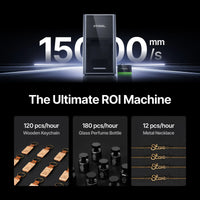
⚡ 15,000 mm/s Galvo Speed for Batch Production
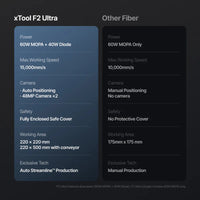
At 15,000 mm/s, the F2 Ultra is xTool's fastest galvo engraver — 50% faster than the F1 Ultra's 10,000 mm/s. Combined with an 8.6″ × 8.6″ (220 × 220 mm) work area, it's built for high-volume batch engraving of small items: business cards, tags, jewelry, hardware, and branded merchandise.
🔩 Full Metal Processing — Engrave, Emboss, and Cut
The MOPA fiber laser handles the full range of metal processing: surface engraving, deep engraving, embossing effects, color marking, and cutting thin metal sheet stock. Compatible metals include stainless steel, brass, aluminum, gold, silver, titanium, and more. The 40W diode laser handles non-metal cutting and engraving.


Technical Specifications
| Feature | Specification |
|---|---|
| Laser 1 | 60W MOPA fiber laser |
| Laser 2 | 40W diode laser |
| Max Engraving Speed | 15,000 mm/s |
| Work Area | 220 × 220 mm (8.6″ × 8.6″) |
| Camera System | Dual 48MP (panoramic + close-up) |
| Color Marking | 100+ colors on metal (MOPA) |
| Metal Capability | Engrave, emboss, color mark, cut thin sheet |
| Safety | Enclosed cover, eye-protection window, fire safety stop |
Frequently Asked Questions
What makes MOPA fiber different from a standard fiber laser? A standard fiber laser has fixed pulse characteristics. A MOPA laser allows independent adjustment of pulse width and repetition frequency, giving precise control over how the laser interacts with metal surfaces. This is what enables consistent color marking — standard fiber lasers cannot reliably produce a full color spectrum on metal.
How many colors can the F2 Ultra produce on metal? The 60W MOPA fiber laser unlocks 100+ consistent colors on stainless steel and compatible metals through controlled oxidation. Colors are repeatable across batches, making it suitable for production use.
How does the F2 Ultra compare to the xTool F1 Ultra? The F2 Ultra steps up in three key areas: the fiber laser is 60W MOPA vs. the F1 Ultra's 20W standard fiber (enabling color marking and more power), the diode laser is 40W vs. 20W (deeper cuts in organics), the camera system is 48MP vs. 16MP, and engraving speed is 15,000 mm/s vs. 10,000 mm/s. The F2 Ultra is xTool's top-tier desktop system for metal-focused and production workflows.
Is the F2 Ultra safe for home or studio use? Yes. The enclosed cover contains laser radiation during normal operation. The eye-protection window allows visual monitoring without exposure. The fire safety stop provides hardware-level protection during extended runs.
